A documented landmark
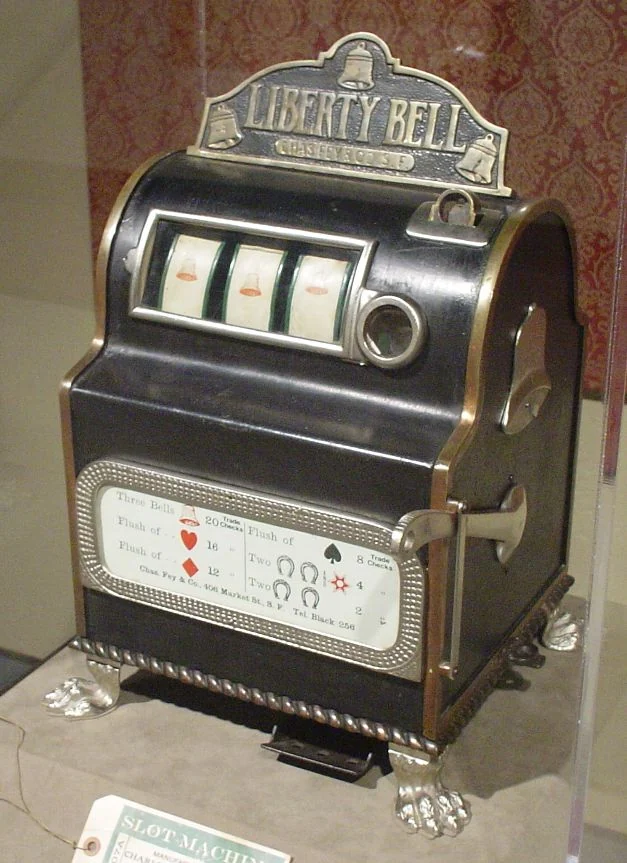
California’s landmark record credits Charles August Fey with inventing a coin-operated, three-reel slot machine in San Francisco in 1895. It also records that his Market Street workshop operated from 1897 until its destruction in the earthquake and fire of 1906. The landmark is evidence of how the invention is commemorated, as well as a source for the chronology.
Accounts of invention often use different milestones: an experiment, a working model, a commercial introduction or a patent. A responsible history names the record it follows rather than making every early machine fit a single origin story.
Section sources: [1] California State Parks
The cabinet as a mechanism
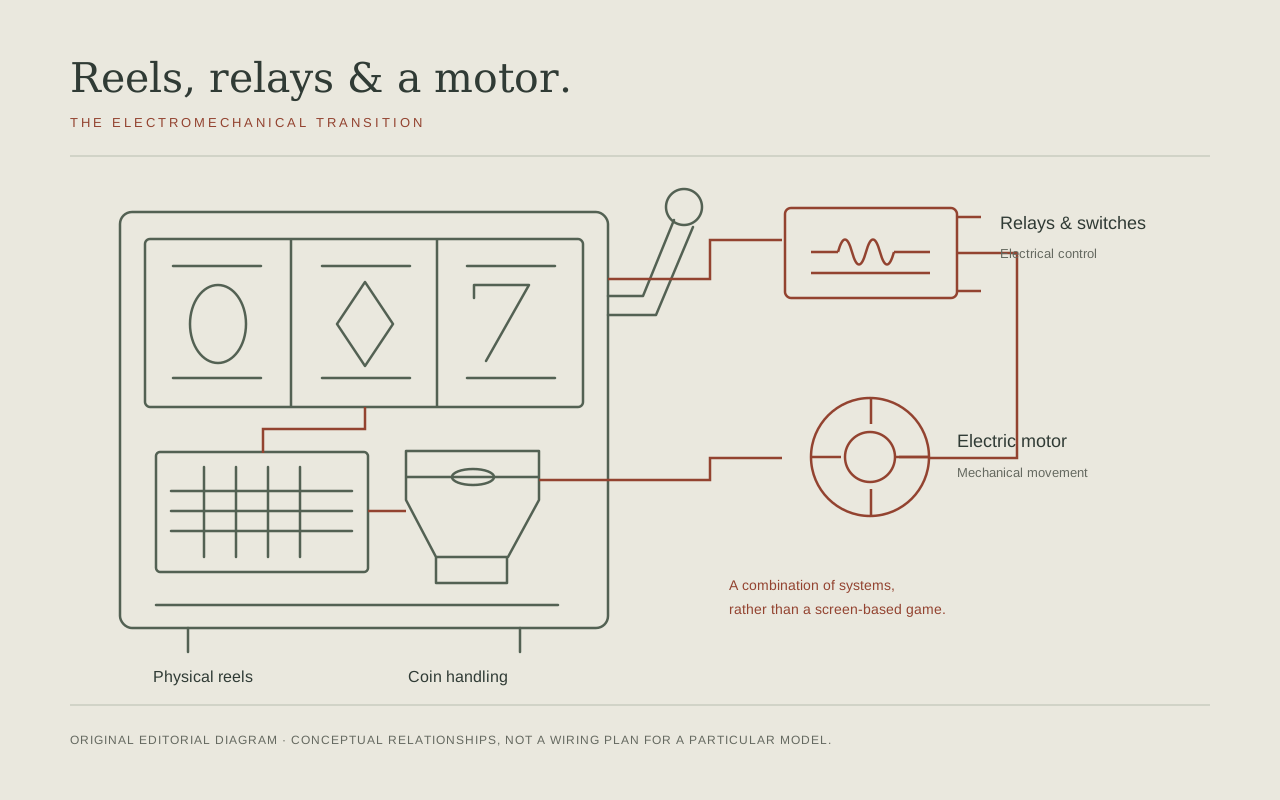
In a mechanical device, the user-facing lever and reels belonged to a physical assembly. Coin entry, moving parts and the payment mechanism had to work together. The reel windows also made a complex internal process legible through a small set of visible symbols.
This is a useful way to read surviving objects. The cabinet is not just a decorative container: its openings, access panels and fittings express the functions it was built to perform. An object’s surface and its internal mechanism belong to the same design history.
Editorial context and interpretation.
From invention story to material history
Marshall A. Fey’s 1975 article in California Historical Quarterly is listed as further reading. The catalogue establishes its author, journal, date and page range; that bibliographic entry is not treated as proof of additional details from pages that a reader may be unable to access. The dated invention claim in this article follows California’s public landmark record.
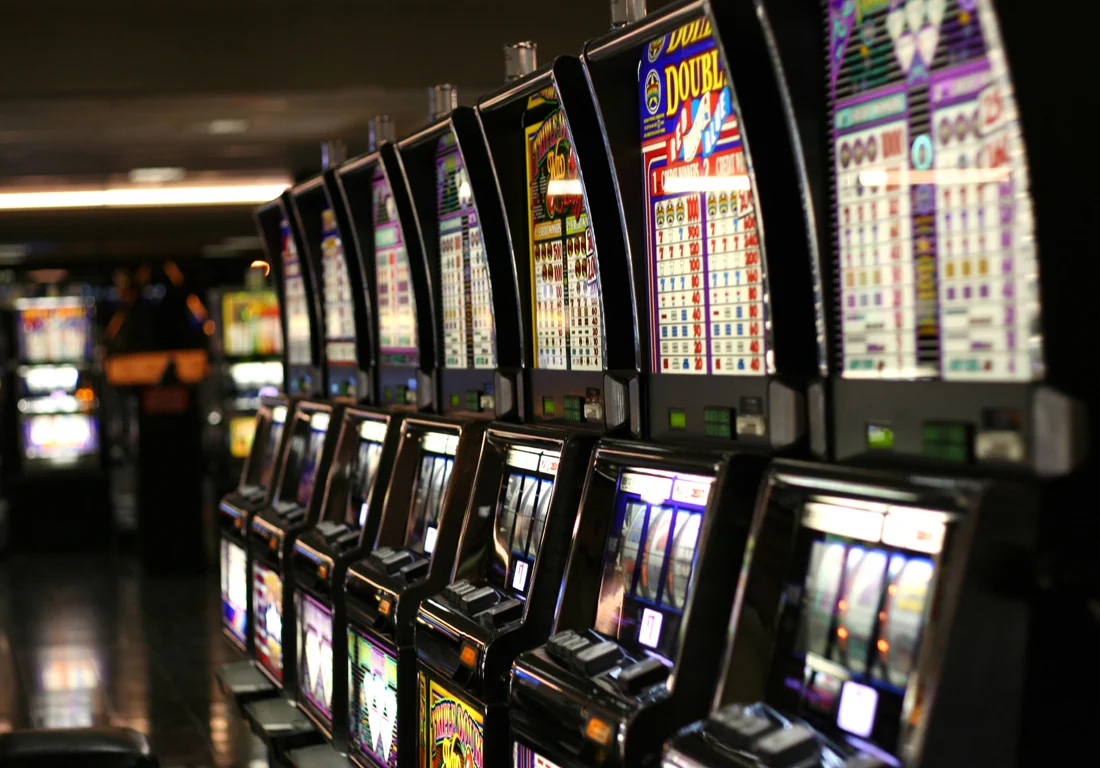
Later Australian machines in the Powerhouse Collection demonstrate how widely the cabinet form travelled and how local manufacture became part of the story. The mechanical era did not end everywhere at one moment. Technologies can coexist, and older machines can remain in use after a newer design becomes available.
Section sources: [2] Marshall A. Fey, [3] Powerhouse Collection
Reading a surviving cabinet
The Powerhouse’s Apex record describes a coin-operated machine made in Balmain, Sydney. The case combines metal, paint, wood and woodgrain laminate. These details show why a catalogue entry is useful even when it does not offer a dramatic invention story: it records the actual construction of a surviving object.
For the mechanical era, cabinet form also raises practical questions. How was a device positioned in a room? Where could a coin be inserted or a payment collected? Which surfaces were made for the user and which for servicing? Those questions turn an old machine into evidence about manufacture and use. They do not require operating the device or treating it as an invitation to play.
Section sources: [3] Powerhouse Collection
Sources & further reading
Source links support the historical details in the sections indicated. Interpretive passages are labelled separately. Corporate histories are used for dated events, not recommendations.
- California State Parks — Three-reel bell slot machine landmark ↗
State landmark 937 dates Charles Fey’s invention to 1895 and records the loss of his workshop in 1906.
- Marshall A. Fey — Charles Fey and San Francisco’s Liberty Bell Slot Machine ↗
California Historical Quarterly, volume 54, number 1 (1975), pages 57–62. Bibliographic record; full text may require access.
- Powerhouse Collection — Apex poker machine ↗
Museum record of a Sydney-manufactured machine dated 1956–1960.
Links and historical details reviewed on 21 October 2026. A source may contain older figures or promotional language; neither is treated as current advice here.
Read our editorial policy →