Small objects, substantial evidence
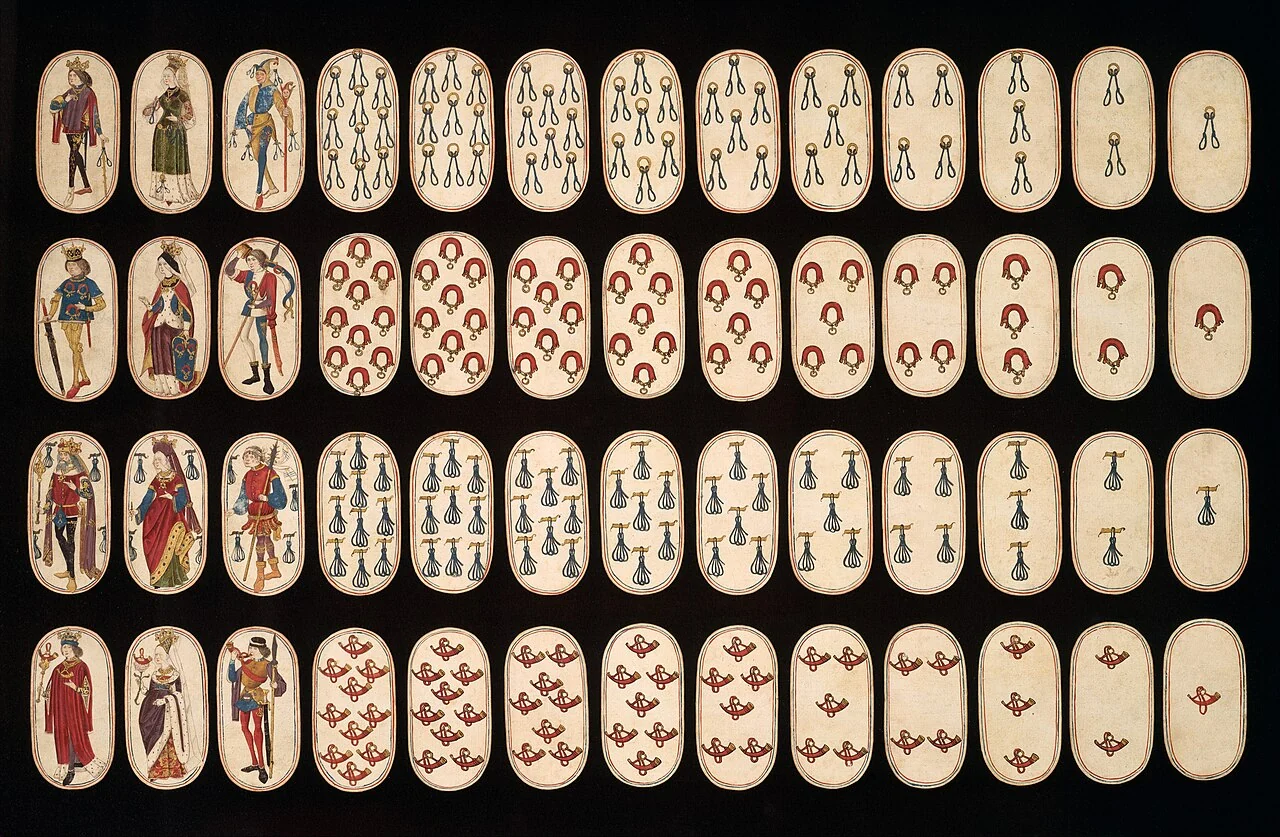
The Metropolitan Museum’s Cloisters deck is a surviving complete set of fifty-two fifteenth-century playing cards. Its hunting imagery is a reminder that the visual system of a card deck was not always identical to the familiar modern suits.
The museum warns that the exact play of some historical games is unknown. This is an important limit: a complete physical set can still leave an incomplete account of the activity for which it was made. Objects preserve some kinds of information more readily than others.
Section sources: [1] The Metropolitan Museum of Art
Art, manufacture and circulation
The Met’s exhibition The World in Play brought together luxury cards made between 1430 and 1540, including hand-painted and printed examples. It presented them as works of art and evidence of production, rather than treating them simply as equipment.
The V&A’s reconstruction of early-Renaissance cards adds the practical perspective of printmaking. Repeated images, sheets and the stages of colouring or cutting help explain how a deck became a reproducible object. The production process is part of the history of play.
Section sources: [2] The Metropolitan Museum of Art, [3] Victoria and Albert Museum
Why this belongs in casino history
A commercial table game depends on legible and recognisable equipment, but that equipment has a longer cultural life. Card imagery, manufacture and collection developed in settings that should not be reduced to modern casino use.
Keeping that wider history in view prevents an overly narrow origin story. A deck can be evidence of artistic patronage, printing or social activity without proving the rules of a later game. The most convincing historical account allows an object to remain complicated.
Editorial context and interpretation.
Sources & further reading
Source links support the historical details in the sections indicated. Interpretive passages are labelled separately. Corporate histories are used for dated events, not recommendations.
- The Metropolitan Museum of Art — The Cloisters Playing Cards ↗
Museum record for the surviving fifteenth-century deck and the limits of reconstructing its games.
- The Metropolitan Museum of Art — The World in Play ↗
Exhibition on luxury playing cards, 1430–1540, and their artistic production.
- Victoria and Albert Museum — Recreating early-Renaissance playing cards ↗
Museum explanation of the production of early printed cards.
Links and historical details reviewed on 21 October 2026. A source may contain older figures or promotional language; neither is treated as current advice here.
Read our editorial policy →