1863: an institution takes shape
Monte-Carlo’s history is inseparable from the Société des Bains de Mer, founded by royal decree in 1863 under Prince Charles III. The company’s history identifies François Blanc, arriving from Homburg, as a central figure in the development of the casino enterprise. The surrounding district received the name Monte Carlo in 1866.
Those dates describe related but distinct developments. A business concession, a building and the naming of a district should not be collapsed into a single founding moment. The familiar place name was the result of a project already under way.
Section sources: [1] Société des Bains de Mer
Culture beside the gaming rooms
In 1878 Marie Blanc commissioned Charles Garnier to enlarge the casino and create a concert hall. The Opéra de Monte-Carlo records its inauguration on 25 January 1879, with Sarah Bernhardt taking part. The theatre’s own history is particularly valuable because it identifies the people and construction programme behind a building often presented simply as an icon of luxury.
The opera house complicates a history told only through gambling revenue. Performance and architecture could lend cultural prestige to a resort and give visitors reasons to travel beyond the gaming room. The casino was part of a carefully assembled destination, rather than an isolated business.
Section sources: [2] Opéra de Monte-Carlo
Reading the surviving image
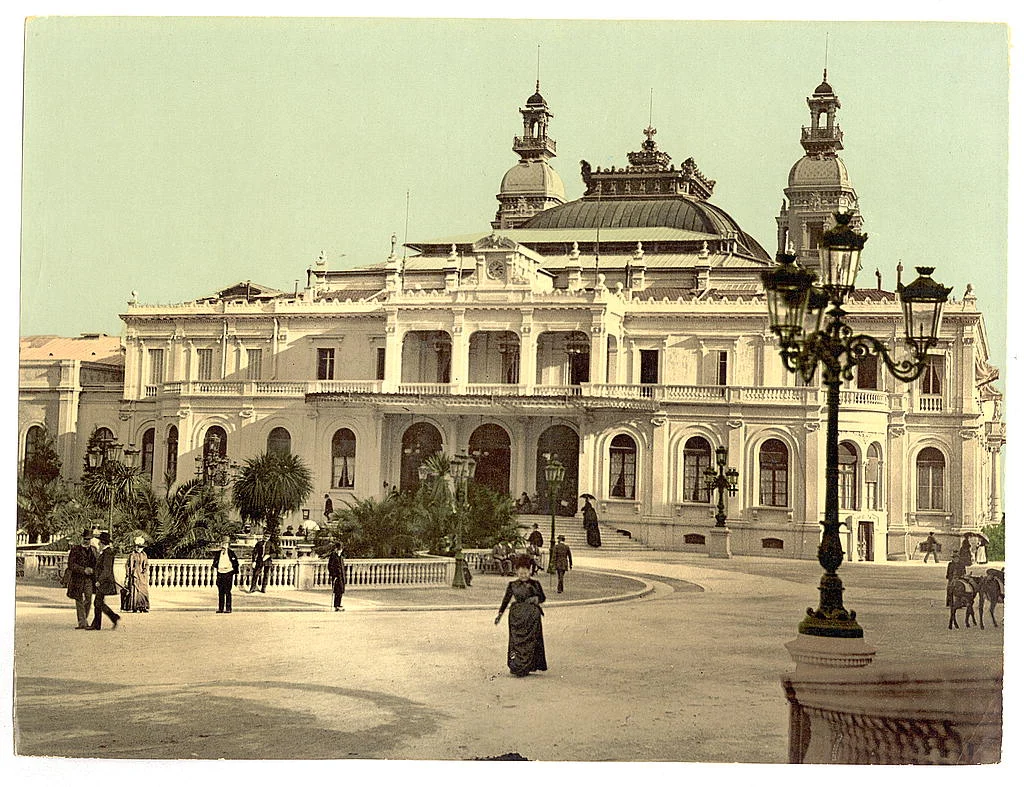
Late nineteenth-century photochrom views preserved by the Library of Congress show the casino as a landscaped architectural attraction. Such images are evidence of how the resort was represented to travellers. Their colour printing, framing and chosen viewpoints also remind us that an archive image is a constructed view, not a neutral survey.
Monte-Carlo’s historical importance lies in the relationship between private enterprise, princely authority and destination-making. Its buildings and cultural programme helped create a recognisable place. That legacy can be studied without turning a history of the resort into a recommendation to gamble there.
Image record: Library of Congress. The interpretation of the image is editorial.
A district assembled around a square
The company chronology places the predecessor of the Café de Paris in 1868 and records further casino rooms in 1881 and 1890. Those additions make the development easier to understand as an ongoing construction programme. What looks like a single established ensemble in an old photograph was assembled through successive decisions.
The relationship between the square, the hotel and the casino gave the project an urban setting. Visitors could move between hospitality, public gathering and performance rather than encounter the gaming room as a detached building. When reading this history, the surrounding district deserves as much attention as the principal façade. It helps explain how a casino enterprise contributed to a place identity that travelled through photographs, print and the accounts of visitors.
Section sources: [1] Société des Bains de Mer
Sources & further reading
Source links support the historical details in the sections indicated. Interpretive passages are labelled separately. Corporate histories are used for dated events, not recommendations.
- Société des Bains de Mer — Company history ↗
An operator’s institutional history; used for dated events, rather than its promotional assessments.
- Opéra de Monte-Carlo — History of the opera ↗
The theatre’s own account of Marie Blanc, Charles Garnier and the 1879 inauguration; in French.
Links and historical details reviewed on 21 October 2026. A source may contain older figures or promotional language; neither is treated as current advice here.
Read our editorial policy →