The legal foundation
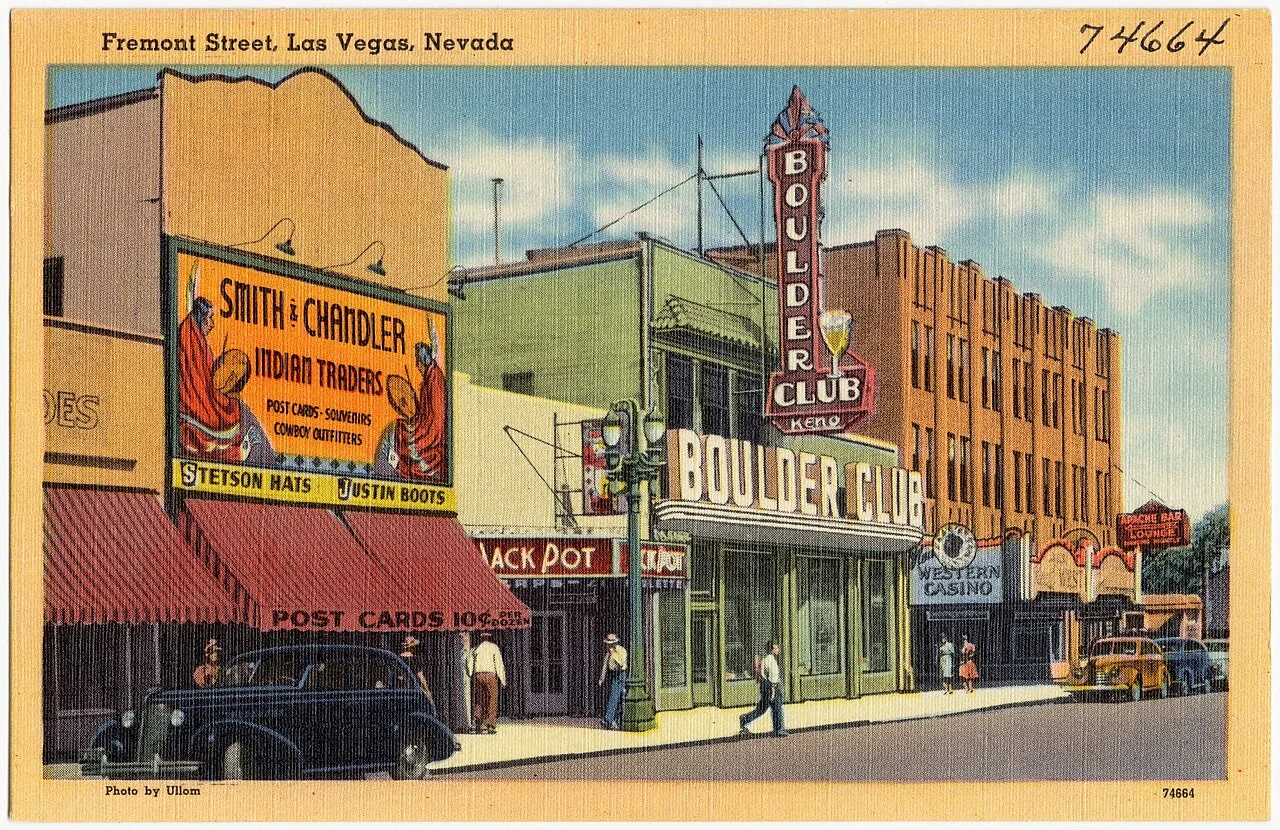
Nevada’s Legislative Counsel Bureau records that Assembly Bill 98 was signed on 19 March 1931, restoring wide-open commercial gambling. The Nevada Resort Association’s chronology places the first Las Vegas licensees in the existing downtown business district. This is an important corrective to accounts that begin with the famous hotels on the Strip: the initial licensed activity had a different geography.
Legalisation made a market possible, but a law is not the same thing as an instantly mature tourism industry. To understand subsequent growth, it is necessary to look at roads, accommodation and the way a business could bring visitors to one site and keep offering them different services.
Section sources: [1] Nevada Legislative Counsel Bureau, [2] Nevada Resort Association
The roadside resort
The Nevada State Museum dates the opening of El Rancho Vegas to 3 April 1941. It describes a resort outside downtown, with an Old West theme and accommodation in cottages. The highway setting offered a different spatial model from a compact urban club.
The Last Frontier followed in 1942, and the Flamingo opened in 1946. The industry chronology makes clear that the Flamingo was not the first Strip resort. Its prominence in popular memory should not displace the earlier properties or the workers who built and operated them.
Section sources: [3] Nevada State Museum, [4] Nevada Resort Association
A city that rebuilds its own history
Las Vegas is also a history of removal. The Neon Museum documents the implosion of the Dunes’ north tower on 27 October 1993 and the demolition of the Sands in 1996, with the sites making way for new resort developments. The Dunes date identifies a specific demolition event, rather than the disappearance of every structure at once. Surviving signs and photographs preserve evidence that the buildings themselves no longer provide.
The result is a landscape where historical continuity is often found in collections rather than intact streetscapes. A casino’s closing date, a building’s demolition and a successor’s opening are separate events. Keeping those distinctions visible helps explain how the city repeatedly changed its public identity.
Section sources: [5] The Neon Museum, [6] The Neon Museum
Corporate ownership and the larger resort
Nevada’s 1967 legislation allowed public corporations to own gaming facilities without individually licensing every shareholder; the law was modified in 1969. The Nevada Resort Association places this change beside Howard Hughes’s acquisitions and the opening of major new properties. The development of the industry was therefore also a history of corporate organisation and access to capital.
The International opened in 1969, while The Mirage opened in 1989. These milestones broaden the story beyond the first roadside hotels. Resorts became increasingly elaborate combinations of accommodation, entertainment and presentation. The chronology is not a claim that one opening alone caused the later boom: legislation, ownership, visitor markets and construction interacted over several decades.
Section sources: [1] Nevada Legislative Counsel Bureau, [7] Nevada Resort Association, [8] Nevada Resort Association
Sources & further reading
Source links support the historical details in the sections indicated. Interpretive passages are labelled separately. Corporate histories are used for dated events, not recommendations.
- Nevada Legislative Counsel Bureau — Gaming in Nevada, 2016 ↗
Legislative Research Division report, April 2016, printed pages 2–3: the 1931 relegalisation, the 1955 and 1959 regulatory bodies, and corporate gaming legislation in 1967 and 1969.
- Nevada Resort Association — The 1930s ↗
Industry chronology of Nevada’s 1931 legalisation and early licensees.
- Nevada State Museum — El Rancho Vegas ↗
Museum account of the 1941 resort, its cottage layout and roadside setting.
- Nevada Resort Association — The 1940s ↗
Chronology of the early Strip resorts and hotel development.
- The Neon Museum — The Dunes’ dramatic demolition ↗
Museum account identifying the north tower and its sign in the 27 October 1993 implosion. The event is not described here as the simultaneous demolition of every building on the property.
- The Neon Museum — History of demolished hotels in Las Vegas ↗
Museum chronology of the Dunes, Landmark, Sands and other demolished properties.
- Nevada Resort Association — The 1960s ↗
Industry chronology of corporate ownership legislation, new properties and Howard Hughes’s acquisitions.
- Nevada Resort Association — The 1980s ↗
Chronology of The Mirage’s 1989 opening and the expanding resort model.
Links and historical details reviewed on 21 October 2026. A source may contain older figures or promotional language; neither is treated as current advice here.
Read our editorial policy →